

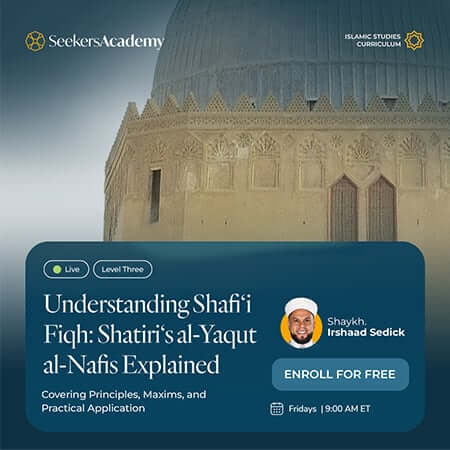
This course provides a clear and practical introduction to the core principles of the Shafi‘i School through studying al-Yaqut al-Nafis, a concise yet deep manual written by the prominent Yemeni scholar, Shaykh Aḥmad ibn ʿUmar al-Shatiri.
Designed for learners of all levels, this course examines the essential rules, maxims, and principles that guide the application of Shafi‘i Fiqh, providing a reliable framework for understanding both traditional rulings and modern issues. The author's commentary, based primarily on his teacher, the renowned Shaykh ʿAbd Allah ibn ʿUmar al- Shatiri, clarifies complex points and presents the living tradition of sacred law in an easy-to-understand, learner-friendly manner.
- Teacher: Mawlana Irshaad Sedick
Display on Both categories: Yes
Category Featured: Yes
Show in catalog: Yes
Weightage: 0
Skill Level: Beginner
Monday: No
Tuesday: No
Wednesday: No
Thursday: No
Friday: Yes
Saturday: No
Sunday: No
Class Time: 8:00 AM ET
About the text:
Al-Yaqut al-Nafis in the Madhhab of Ibn Idris, According to the Jurisprudence of the Noble Shafiʿi School
This noble book, al-Yaqut al-Nafis, is a valuable and comprehensive work that compiles the essential foundations, principles, and legal maxims shaping the framework of Islamic jurisprudence in the Shafii school. It explains the conditions that prohibit or permit, clarifying their meanings and how they apply in real life. What makes this book stand out is its clarity; it is concise without being too brief, eloquent without being hard to understand, and thorough in its explanations. It leaves no critical point unaddressed for the student of knowledge. The author’s student, al-Allamah Salim bin Said Bakyir Baghithan al-Tarimi, annotated the text. The book is rich in legal maxims (qawaid), making it easier for students to memorize and understand the principles that determine rulings on various legal issues (masa’il).
From the initial steps of his journey until he achieves advanced understanding, the student of sacred knowledge must memorize and internalize foundational principles. These principles help him grasp the main topics of fiqh and their related subtopics. With them, the student becomes prepared to explore deeper issues, answer new questions, and handle emerging legal matters with insight and confidence.
Yet, we have observed that many students struggle. Because their study resources are so diverse, they often spend a lot of time searching, sometimes pulling from long marginal notes, other times relying only on teachers' words, without ever finding a single, well-organized reference that consolidates all the necessary foundations in one place.
In response to this need, the noble scholar, the caller to Allah, our Shaykh and teacher, Abd Allah ibn Umar al-Shatiri (may Allah protect him and preserve his light), who has dedicated his life to teaching and guiding students, recognized the challenges students faced. He commissioned his student, Ahmad ibn Umar al-Shatiri, to write a book that would gather these essential rules and principles in an organized and accessible way. The aim was to make the path easier for students and prevent unnecessary hardship.
And so, our Shaykh Ahmad ibn Umar al-Shatiri (may Allah be pleased with him) took on this task and authored al-Yaqut al-Nafis. He fulfilled his teacher’s vision and enriched the work with valuable commentary, detailed notes, and clarifying remarks. These additions became essential reading for students and scholars, teachers, judges, muftis, and legal professionals, who found in this book what they often look for in many others.
You’ll find al-Yaqut and its commentary elegant in language, comprehensive in scope, and smooth in flow. They serve the beginner, support the intermediate, and strengthen the advanced student.
May Allah reward its author and everyone involved in its writing, printing, and distribution among Muslims with the best rewards.
Fadl ibn Muhammad ibn Awad Bafadl al-Tarimi
Who is this course for:
-
Beginner and Intermediate Students of Knowledge
Those who wish to build a reliable foundation in Shafi‘i Fiqh, starting with clear principles before diving into more detailed rulings. -
Advanced Students and Researchers
Learners who have already studied parts of fiqh and now want to consolidate their understanding of the essential usul (principles) and qawa‘id (maxims) of the Shafi‘i school in a structured way. -
Legal Professionals
Those who engage in issuing rulings or advising on Islamic law, as this text provides a concise yet comprehensive consolidation of the principles that underlie Shafi‘i jurisprudence. -
General Learners and Professionals
Muslims from all walks of life who want to understand the reasoning behind rulings, apply fiqh to modern issues, and strengthen their practice of religion with insight and clarity.
This work is traditionally studied after Safinat al-Naja (Ship of Salvation). It covers a broader range of topics but does not go into intricate details. Instead, it serves as a foundational manual that equips the student with the essentials of fiqh.
Learning outcomes:
- Grasp the key legal principles that structure Shafiʿi jurispruden.
- Learn how to approach fiqh systematically, guided by sound methodology.
- Build the skills needed to connect foundational knowledge with real-life scenarios.
- Benefit from a text that has served scholars, judges, and students across generations.
- Grasp precise definitions, conditions, and applications of the complete range of Fiqh topics.